
Physical AI “Hands” Grasp Industry: Dexterity
Interview with Samir Menon, Founder & CEO of Physical AI Startup Dexterity

Every morning, hundreds of millions of people around the world shop online. In the United States alone, more than 100 million parcels are delivered each day. Behind this massive flow lies a logistical infrastructure of staggering scale: enormous warehouses that operate around the clock, millions of workers lifting, sorting, and packing boxes. The costs generated in the process account for a significant share of global GDP.
Yet there is a problem. Compared to other industries, logistics has fallen dramatically behind in technological progress. Cars have entered the era of electrification, smartphones are now equipped with AI chips—yet logistics warehouses still rely heavily on manual human labor. It is a puzzling discrepancy.
In 2017, a quiet shift began. A Stanford PhD student founded “Dexterity.” True to its name—derived from the Latin dexter (right hand)—his goal was to replicate the dexterity of the human hand through AI. At first, few paid attention. Robotics was an old field, and warehouse automation had already been attempted by many companies. But this company was not merely a robot manufacturer.
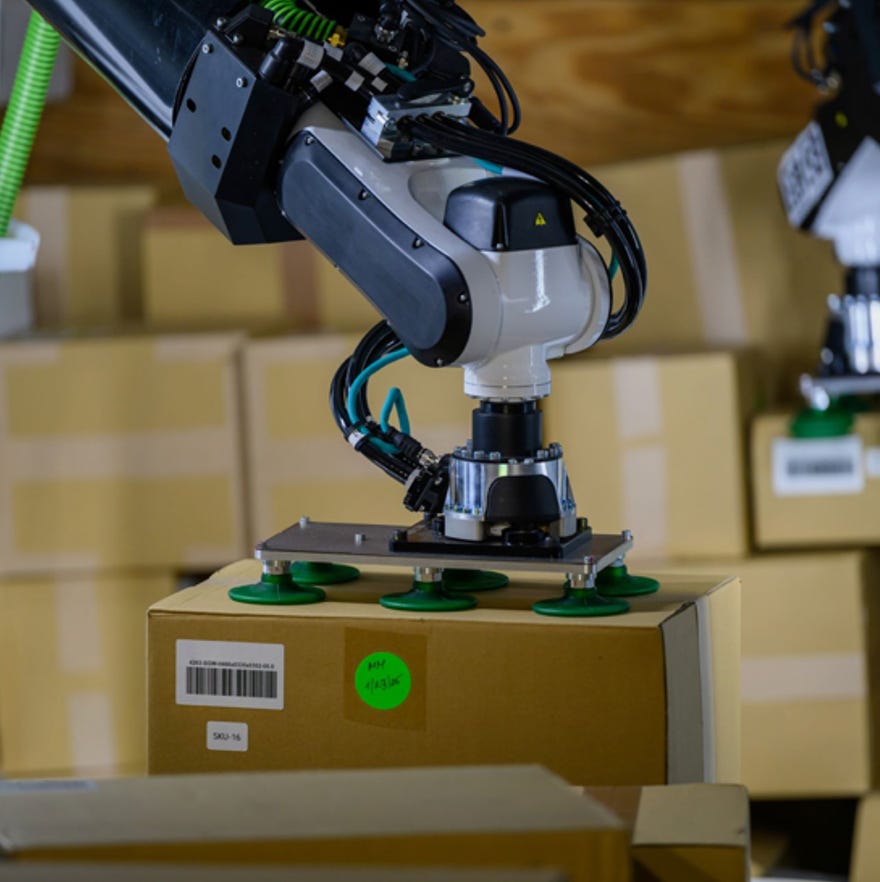
What Dexterity champions is “Physical AI,” artificial intelligence that operates not in the digital realm but in the physical world. Its core lies in the “intelligence of the hand.” A human hand can, without prior instruction, intuitively recognize the texture, center of mass, and friction of an object and adjust its movement on the fly. Dexterity reconstructs this intuition through mathematical modeling and data learning, enabling robots to reliably grasp irregularly shaped objects, realign themselves after unexpected collisions, and select from a range of gripping strategies.
The aim is not a robot that simply repeats pre-programmed motions, but one that perceives, learns autonomously, and adapts to unpredictable environments. This is why Dexterity’s robots demonstrate their true capabilities not on standardized production lines, but in the variable, high-entropy settings of warehouses and fulfillment centers.
In Dexterity’s early days, many were skeptical. Logistics automation was an area even tech giants like Amazon were advancing only slowly through their in-house robotics divisions. It seemed improbable that a startup could break through. But circumstances shifted. The COVID-19 pandemic struck, and the global logistics system was thrown into disarray.
Paradoxically, the pandemic made the need for logistics automation universally apparent. Vulnerabilities across supply chains were exposed, and labor patterns shifted dramatically. Most importantly, large enterprises began seeking new technology partners. Dexterity seized exactly that moment.
Global logistics leaders such as FedEx and UPS came knocking. Samir Menon, Dexterity’s CEO, listened intently to their voices—not merely offering technical solutions, but approaching customers’ real-world problems as joint missions. A warehouse manager’s complaint that packages got soaked when it rained, an engineer’s concern that robots overheated in high-altitude environments, an executive’s insistence that without absolute reliability, no operation was feasible—these became the foundation guiding Dexterity’s technical development.
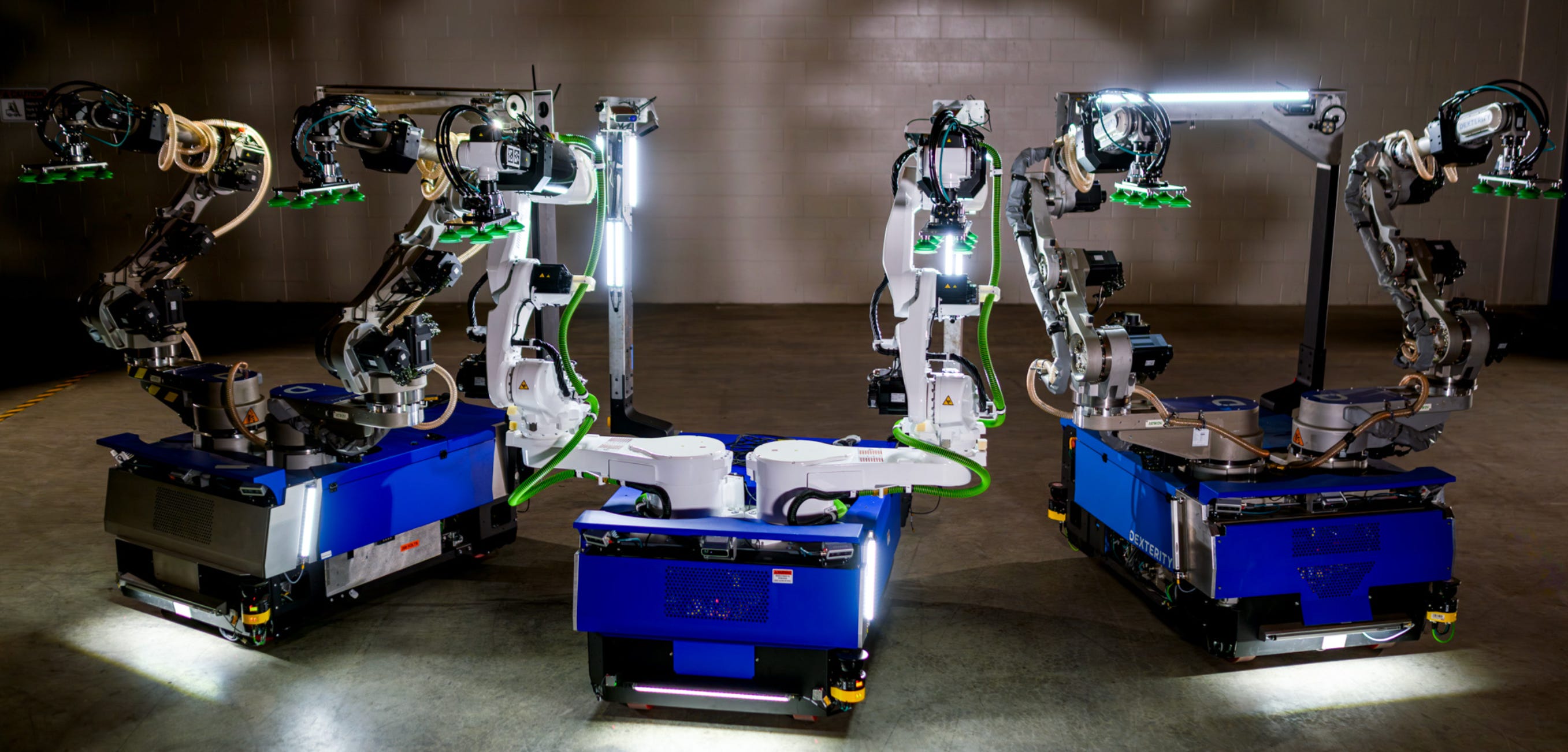
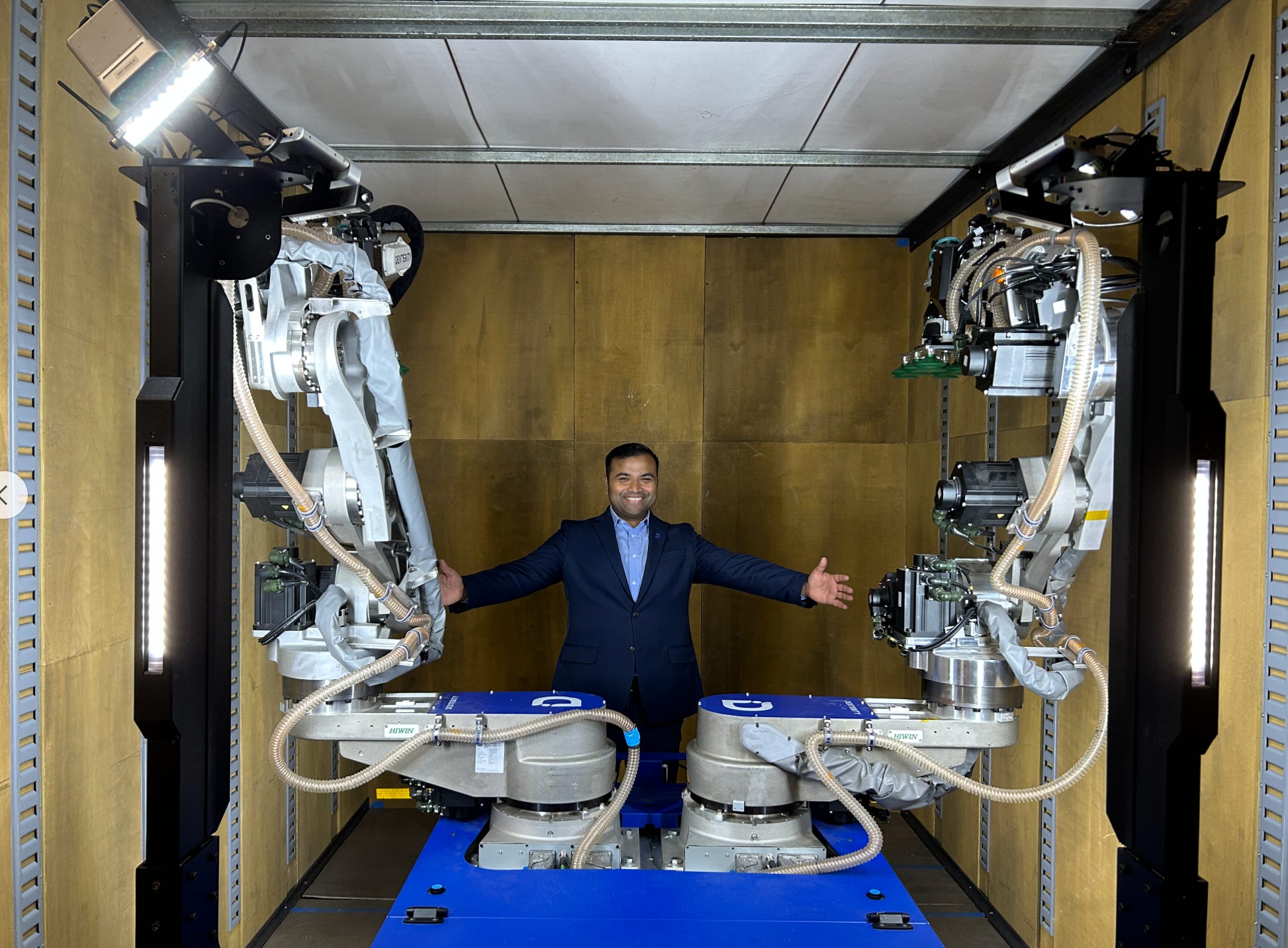
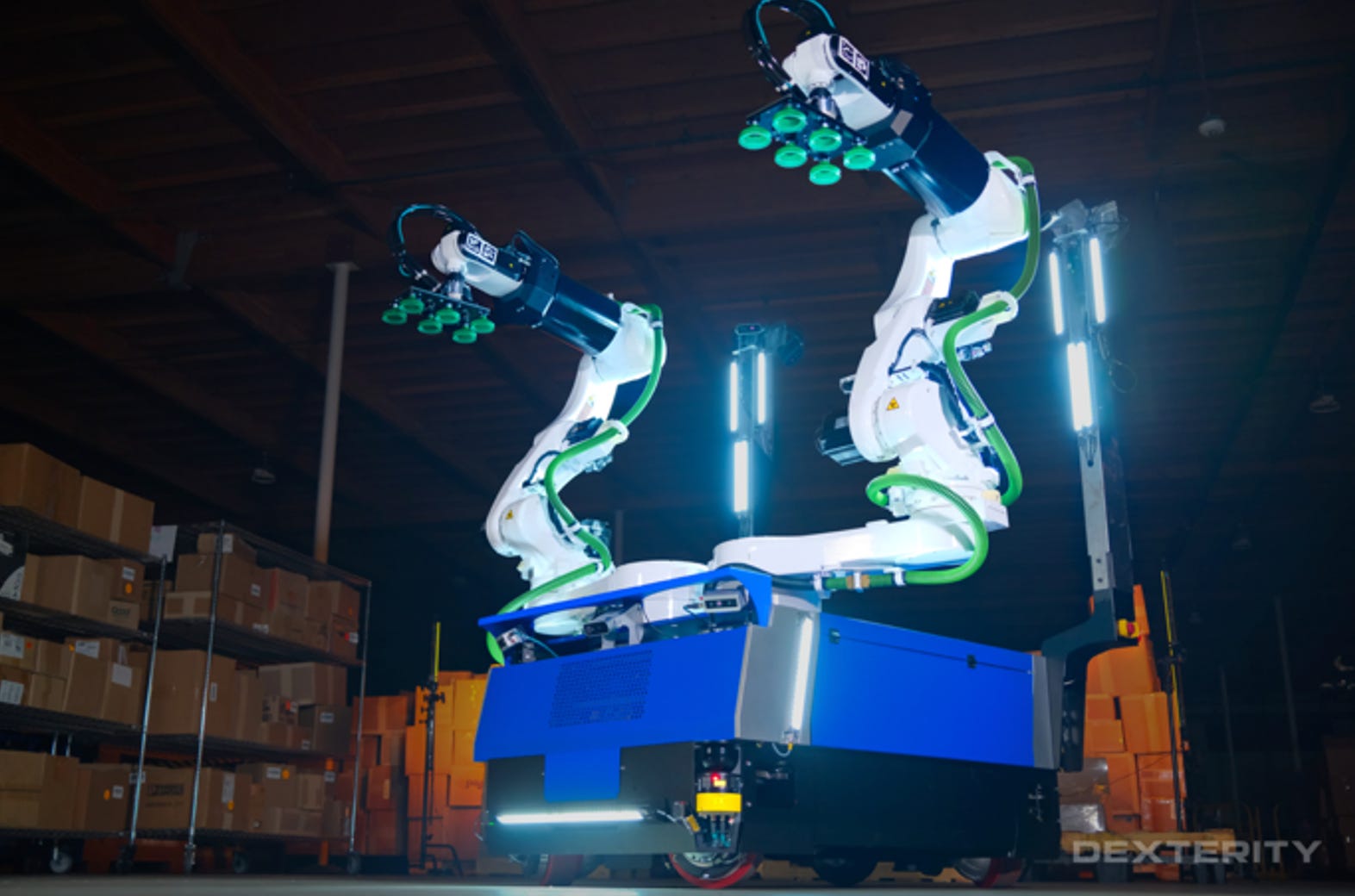
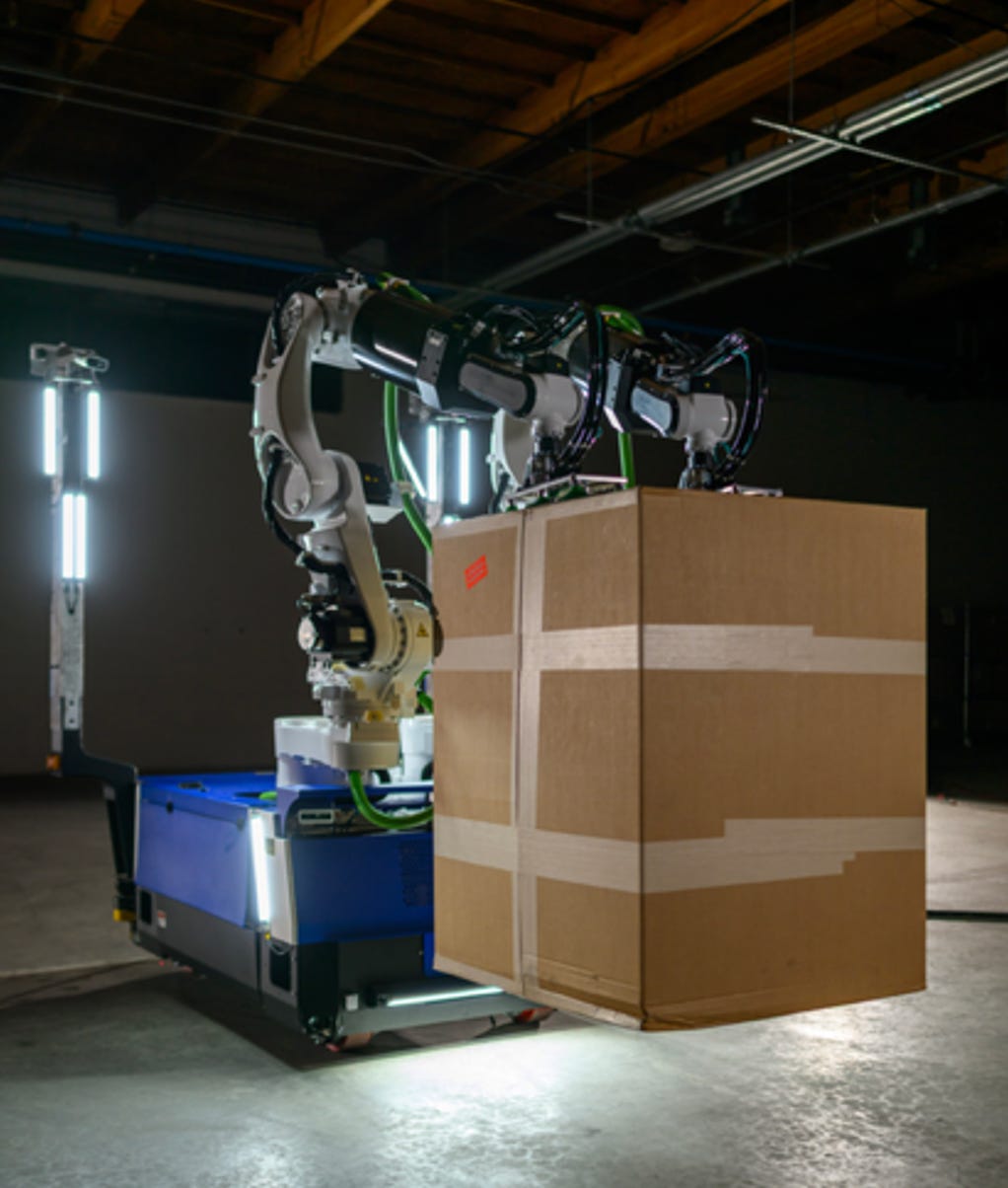
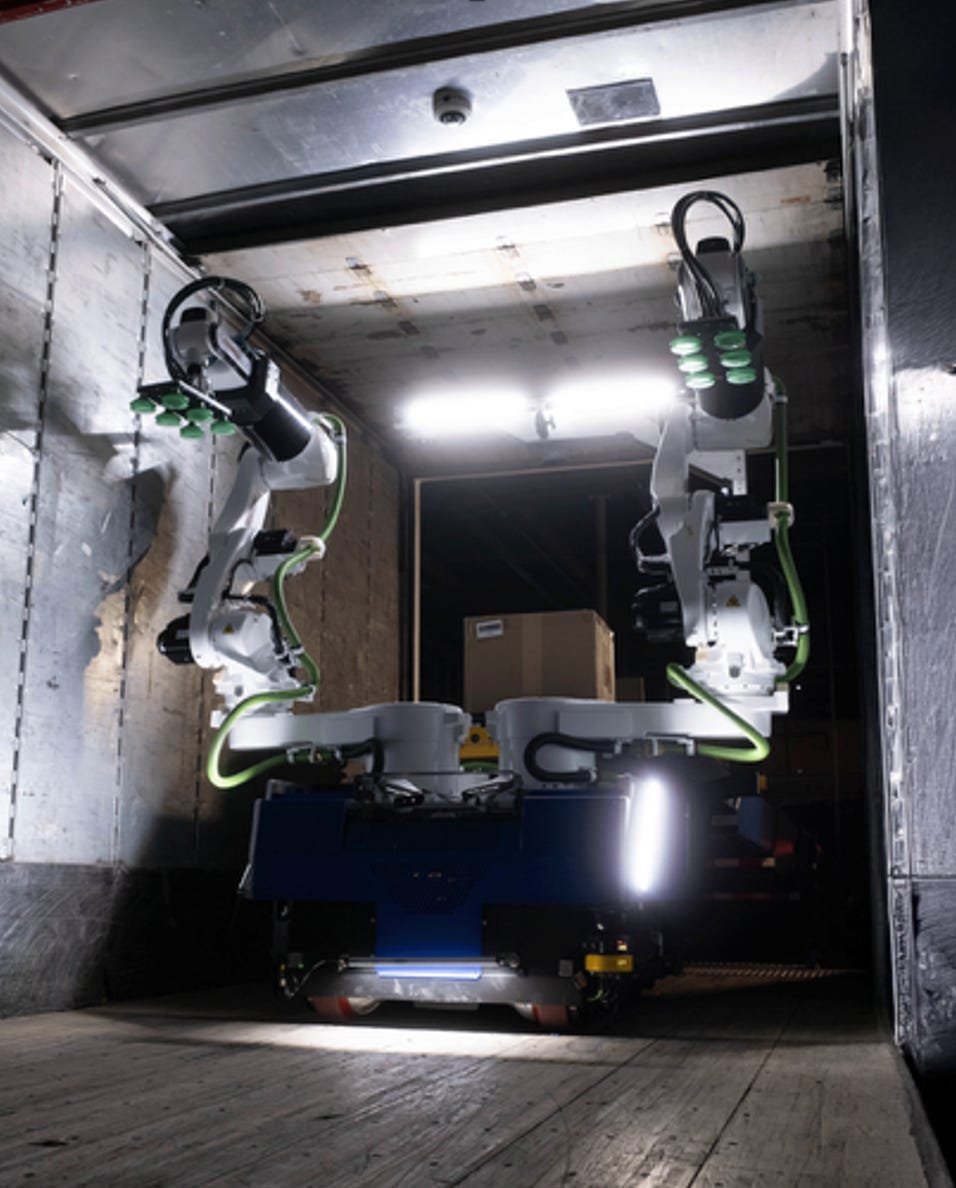
The results were dramatic. In just three to four years, Dexterity transformed from building traditional humanoid robots to creating something entirely new. The two-armed robot named “Mech” was born. It may seem simple—two powerful arms mounted atop a wheeled base—but it was a breakthrough no one had achieved in 50 years of robotics history. It realized the “holy grail” of logistics: automated truck loading and unloading.
This technological leap quickly drew attention in capital markets. Recently, Dexterity secured major investments from prominent venture capital and strategic investors, including Lightspeed Partners, Kleiner Perkins, and Japan’s Sumitomo Corporation. As a result, the company achieved a valuation of $1.65 billion, earning recognition as a “unicorn,” and is now pursuing a U.S. IPO.
What most distinguishes the company is the balance between deep technical prowess and humility. In every decision, it prioritizes the customer’s perspective. It has a keen understanding of the gap between theoretical work and real-world conditions. The company is known for respecting even seemingly minor questions posed on logistics floors—such as, “Packages get wet when it rains; can your robot pick up wet boxes?”
Samir Menon often notes that after spending years immersed in mathematical equations at Stanford, it was only when he stepped onto the warehouse floor and confronted real problems that he truly grasped the essence of technology.
This past August, I visited Dexterity’s headquarters in Redwood City, California, to speak with CEO Samir Menon.
The Seed of Entrepreneurship: A Conviction in Physical AI
― Please tell us about the reason you started Dexterity and the journey you took.
“I grew up dreaming about robots and AI. Watching science-fiction movies and things like Transformers, I often wondered: How should this technology be built, and how can it contribute positively to the world?
At Stanford, where I pursued a PhD in computer science, I focused deeply on AI and robotics — especially on understanding human motion. My belief was that if we could truly understand how humans move, we could transfer those abilities into robots so that robots could perform human capabilities.
Along the way, I met exceptional colleagues and was exposed to the long history of research in physical AI and robotics, which strengthened my conviction.
As I approached graduation, I asked myself: Is now the right time? Physical AI is a technology that will inevitably become reality. The question was timing. Looking at the market, the opportunity was enormous. Jensen Huang, CEO of NVIDIA, projects that physical AI could represent 40–50% of global GDP; even a conservative estimate above 10% is hard to dispute. The market was unquestionably massive.
We confirmed three things: we had confidence in the technology; we had colleagues capable of forming a great team; and the market was ready. Timing was the most critical factor. So, we founded Dexterity in late 2017 and began full operations in early 2018 — and it turned out to be the right decision.
Macro shifts — especially the rise of e-commerce — created the opportunity to commercialize the technology earlier than expected. The environment energized customers, and we were able to begin building world-class physical AI and truly launch a robotic innovation movement. That was our starting point.
Even today, we continue this journey with tremendous anticipation and excitement. The opportunity keeps growing, and technological progress has been astonishing. What AI is demonstrating now was unimaginable just five years ago.”
― Many robotics startups in the 2010s aimed to automate logistics, yet few achieved meaningful success. How was Dexterity able to grow so quickly, and what differentiates you from others?
“Our strategy for success can be explained through three pillars.
First, and most importantly, is customer focus.
In deeply technical fields like robotics, founders typically come from engineering backgrounds. Their first instinct is: “This technology is amazing.” Only then do they ask, “Where can I use it?”
We reversed this order entirely. We began by asking: “What problems do our customers and the market face?” — and then asked, “What technology should we apply to solve those problems?”
This shift in mindset has driven our company in a completely different direction.
Physical AI robots can be used in many places — washing dishes, mining, operating in warehouses, and more. But we spent a lot of time analyzing the economics of each market to determine where commercialization was truly feasible.
The biggest limitation of current robots is environmental uncertainty.
For the past 40–50 years, robots have excelled in highly controlled manufacturing environments, such as automotive factories. There, robots can be extremely precise and reliable. But making such environments precise requires massive cost: if you spend $100,000 on a robot, you may need to spend over $1,000,000 more on precision conveyor belts, perfectly level concrete, alignment systems, jigs, tooling, and so on.
This level of investment is only possible in manufacturing.
The moment you leave that environment, robots become useless. The core problem we needed to solve was enabling robots to perform even within uncertain, real-world environments — such as warehouses, where conditions are not perfectly controlled.
The second pillar is a full-stack approach.
We began with strong capabilities in physical AI and software, but realized that solving the customer’s problem completely required integration across software, AI, and hardware. So we worked closely with hardware partners and built complete solutions.
It isn’t enough to simply identify the customer problem; you must solve it and also build a business that can scale. And you cannot do that with software alone — you need to integrate across the stack.
The third pillar is scalability.
The future trajectory of physical AI remains uncertain. We can understand this by looking at the evolution of digital AI: there were early chatbots, neural networks, and then GPT transformers — preceded by dozens of other approaches, with new ones still emerging every year. Among them, transformers eventually became the foundational technology.
Physical AI will follow a similar path.
Today, we don’t know what the core long-term foundational technology will be. So rather than relying on just one model, we built a platform capable of supporting many AI approaches — transformers, recurrent neural networks, graph neural networks, physics-based simulation, or various combinations of learning and mathematical algorithms.
This flexibility allows us to adapt as physical AI evolves.
Ultimately, Dexterity has been able to differentiate itself through three principles:
solving real customer problems, taking a full-stack approach, and building a platform that can scale.”
Pandemic-Driven Supply Chain Shifts Accelerate Robot Adoption
― Logistics automation isn’t new — for instance, Kiva Systems introduced warehouse robots in the 2000s, but the sector gained major momentum after COVID-19. How did the logistics automation landscape change between the 2010s and the post-COVID era, and how did Dexterity respond to these shifts?
“When starting a company, four things are necessary: the market, the technology, the team, and timing. We founded the company in 2018, and shortly thereafter, COVID struck. It was a massive global event and created three major turning points for us.
First, it became clear to the entire world that logistics supply chains were fragile. One major disruption could severely shake the entire system — and people realized this was directly tied to our survival. As a result, there was tremendous attention placed on logistics and supply chains, and strengthening resilience became an urgent priority. Naturally, this created huge demand.
From the outset, we had positioned logistics as our core market, because we believed logistics would be the first major market where physical AI could take a significant step up in intelligence — and it was also the largest early market. The pandemic only reinforced this conviction, strengthening customer motivation to engage with us strategically.
Second, there was a breakdown in labor patterns.
With the widespread adoption of remote work, many people fundamentally changed how they lived — moving toward more distributed forms of employment. That shift is still rippling through our economy today.
Most notably, we saw a major decline in female labor participation. It dropped sharply during the pandemic and has yet to fully recover.
These labor changes raised an important question:
Should humans continue to perform stressful, injury-prone, physically demanding work?
This question accelerated a positive social perception of physical AI and robotics.
Previously, there had been significant social resistance to physical AI entering people’s daily lives. But the pandemic created a broad consensus that we needed machine assistance. Social acceptance increased dramatically, and customers became much more willing to work with us.
Third, there was an influx of capital.
Large amounts of capital flowed into the market during the pandemic. At Dexterity, we devoted this capital squarely to solving customer problems — that was, and remains, our priority.
To me personally, the most important impact was the social response.
When I go out and show people the robots we’ve built — these “crazy mech robots,” these Transformer-like machines — they smile.
I believe that a smile is more important than anything else.”
― As Dexterity grew into the company it is today, what were the biggest turning points? Were there any “aha” moments, failures, or successes?
“There have been many turning points at Dexterity — it’s difficult to name just one. But one truth remains constant:
The moment customers genuinely believe in our technology is always the biggest turning point.
That matters more than anything else.
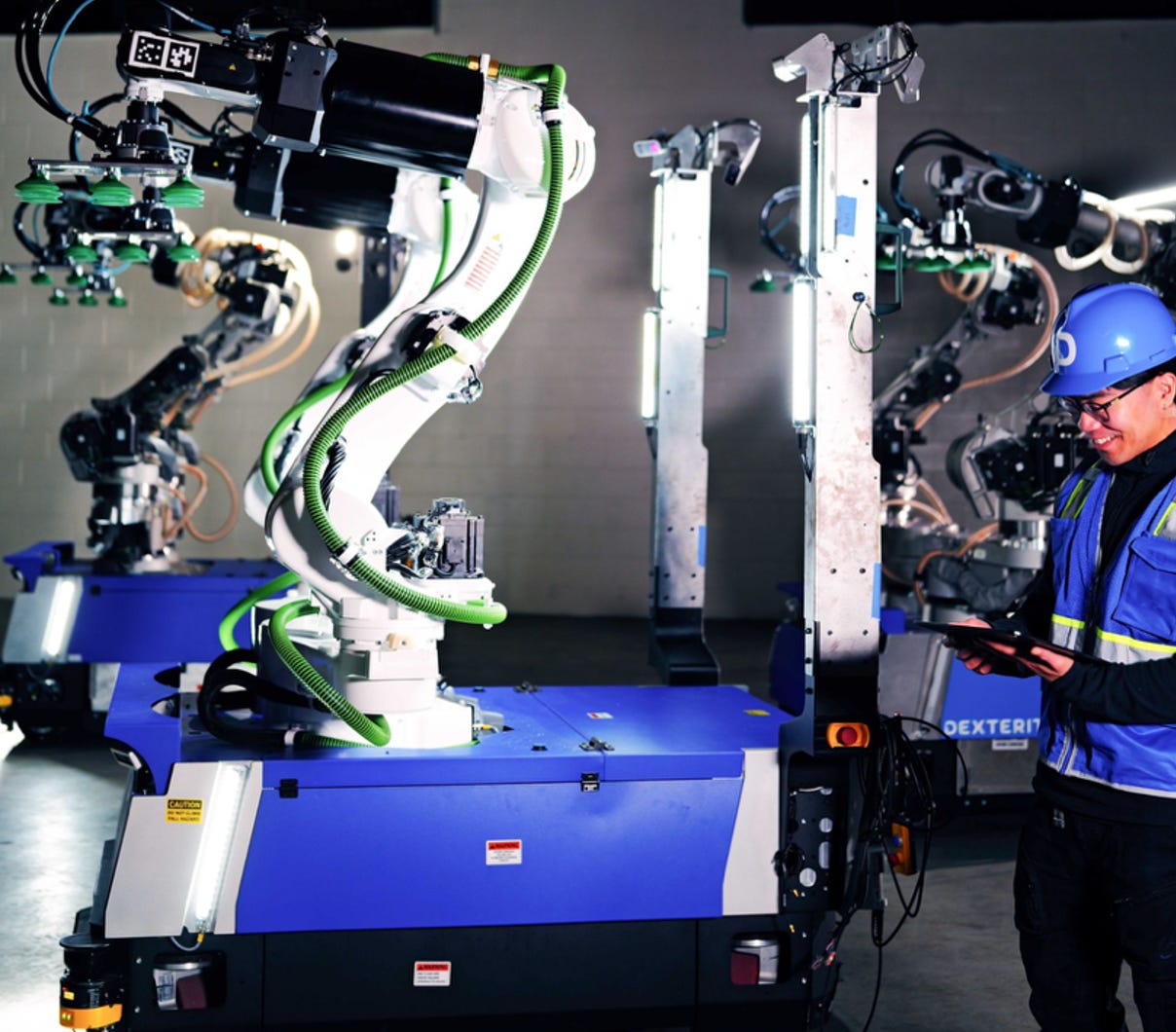
Among those moments, one event had an enormous impact. One of our anchor customers, FedEx, came to us with the application of truck loading and unloading. Until then, we had been solving problems using commercially available off-the-shelf hardware. Our focus had been on building our physical AI capabilities, and we had not spent much effort on robotic arms or supporting infrastructure. We would simply look at a partner’s robot catalog — like Kawasaki — and choose what we needed: “We need Version 7,” or “This time we need RL Version 41,” then add our AI and make it work.
But when FedEx brought us the truck loading and unloading problem, the situation changed completely.
Now the robot had to drive into the truck. That meant we couldn’t bolt it to the ground, and we couldn’t give it legs — because inside such a large box-like truck, a legged robot would simply fall. And the required performance needed to be almost superhuman.
Until then, our philosophy had been clear: “We have to make a robot as good as a human.”
For years, we operated under the goal of human-level performance.
But when we encountered truck loading and unloading, that thinking collapsed — because even humans struggle to perform this task. I myself can’t do it.
The conclusion was obvious:
We didn’t need human-level robots — we needed superhuman robots.
So, over the last three to four years working with FedEx, we made significant investments to build such a superhuman machine. The result was dramatic. The robot evolved from a humanoid-like form into a completely different one — powerful, like something out of Transformers or Pacific Rim. It was a customer-led transformation, and we rebuilt our technology around that demand.
The robot we recently launched — “Mech” — is that machine.
In one sense, it looks almost simple: I joke that “it’s just two powerful arms on a wheeled box.”
But anyone even slightly familiar with robotics knows how technically difficult that is. In 50 years of robotics history, no one had succeeded in building a two-armed, box-shaped robot that could actually load and unload trucks. We made that technology real.
The Mech is built for the market and for customers, and it is solving real problems today. We launched it this March, and we’ve already opened our fifth deployment site. It is currently operating in the U.S. and Japan and is expanding quickly.
A single customer changed our strategy — and in response, we built a technology that had not been achieved in 50 years.”
Earning the Trust of Giants
― The logistics industry is massive, yet notoriously difficult for startups to enter — especially with giants like Amazon operating in-house robotics divisions. Dexterity has managed to collaborate with major players like UPS and FedEx. How did these partnerships come about, and what was the biggest challenge in convincing large companies to trust a startup’s robotic solutions?
“You’re absolutely right. This space is difficult not only because these companies are very large, but also because they carry enormous responsibility to society. Companies like FedEx, Amazon, Walmart, Yosogawa in Japan, and UPS are institutions society relies on every day. If their networks stopped even for a single day, it would be a serious problem. I have deep respect for these companies.
Ultimately, the question is: how do we earn their trust?
The first step in earning trust is genuinely trying to understand the customer. You must build real respect for them, and even for the problems that may seem small on the surface.
I earned my PhD in computer science at Stanford, immersed in a very theoretical world — thinking constantly about math equations and abstract concepts. But when you walk into a warehouse, it’s a completely different world. There, an operator might ask:
“When it rains, my parcels get wet — can your robot pick up a wet parcel?”
There is a huge gap between how theoretical technologists think and how the real world operates.
On the surface, it may look simple — a parcel comes in here, goes out there, and arrives at your house. But in reality, it’s extraordinarily complex. You have to keep people motivated, maintain productivity, hit schedules, deal with weather, shifting buying patterns, equipment failures, and even power outages. Every day is a little bit different.
Dexterity has been able to earn trust because we’ve worked very closely with customers — taking those “small problems” seriously and solving them together. We spend as much time thinking about the math as we do thinking about what happens when it rains and parcels get wet.
We never take trust for granted.
Just because we earned trust yesterday does not mean we deserve it today. We believe we must earn it every single day. If something goes wrong, we must be able to say immediately:
“Sorry — that was our fault, and we will fix it.”
Once you earn respect, you’re given more responsibility. If you execute well, you earn more trust — and that trust brings more responsibility. This cycle compounds. Relationships and trust take time to build, and can be lost very easily. We are very aware of that, which is why we always try to operate with humility.
To be honest, I didn’t always have that mindset. In graduate school, I was arrogant.
But the field taught me — sometimes painfully — that theory and reality are very different. Ultimately, humility is what matters most.
Listening carefully to even the smallest concerns from customers — that humility is the foundation of trust.”
― Dexterity has been actively collaborating with Japanese companies and even formed a joint venture in Japan. What is driving this focus on Japan? Could you share the reasoning and strategic importance behind Dexterity’s partnerships and expansion in the Japanese market?
“I have very high regard for Japan. It is an ally of the United States and a global powerhouse in robotics — many of the world’s largest robot manufacturers are based there. From the beginning, we focused on finding the right robot manufacturing partners in Japan.
We were able to build an excellent relationship with Kawasaki, one of the oldest robot manufacturers in the world. I also have a personal connection there: the first robot I ever programmed was a Kawasaki robot. That nearly 20-year personal connection became a formal collaboration about four to five years ago.
Our initial goal in Japan was to leverage its manufacturing partnerships — tapping into the quality, reliability, and decades of operational excellence that these companies have built in robotics. We believed this would be a tremendous strength for us as a physical AI provider.
After spending time in Japan, we quickly realized something very clear: Japan is not only an enormous market — it also has the highest standards for quality anywhere in the world. Succeeding in Japan means you can succeed anywhere.
When working with U.S. logistics customers, the main challenge is the difficulty of the problem itself; in Japan, the challenge is the quality bar.
If you can meet both standards — solving the hardest problems at the highest level of quality — that is exactly what customers want.
During this journey, we also built a strong relationship with Sumitomo Corporation. With its centuries-long history, Sumitomo has extensive experience bringing new technologies into Japan. With their support, we were able to secure Sagawa, one of Japan’s premium parcel carriers, as a customer. We developed a great relationship with Sagawa, and recently announced our deployment with them in Japan.
At that point, we became convinced that Japan is a tremendous market for physical AI and that we needed a long-term, sustained presence. So we formed a joint venture with Sumitomo.
Sumitomo operates the company, but we are a significant stakeholder in the process of building a business in Japan. This model has worked extremely well so far.
Japan’s high-quality standards and robotics expertise, combined with our physical AI capabilities, have created tremendous synergy. Our success in Japan has given us the confidence to expand globally.
Winning the “Platform Game”
― Over the next 3–5 years, how do you expect the competitive landscape to evolve? With players like Boston Dynamics’ Stretch, Amazon’s internal robotics, and emerging humanoid robots entering the market, what is Dexterity’s biggest competitive advantage, and how do your full-stack and partnership strategies differentiate you?
“Looking back, there was really only one key deal we’ve ever lost to competition — with the United States Postal Service (USPS), which went to FANUC. At the time, we were simply too small as a startup.
Outside of that, we have generally been unchallenged because the applications we focus on are extraordinarily difficult.
The holy grail of logistics is loading large objects such as trucks, containers, and pallets. Today, no company has fully automated that. Some companies can unload containers, but no one has solved the loading problem. We took on the most complex, high-impact problem head-on.
We can break technology development into three buckets — and digital AI offers a useful analogy.
First, the AI itself - OpenAI’s GPT-3 was the first major breakthrough. Second, the applications. Applications like ChatGPT were built on top of these models. Today, there are news aggregators, email organizers, marketing agents — dozens or even hundreds of such applications. Last is the infrastructure. In digital AI, the infrastructure is data centers.
Physical AI has the exact same structure — applications, AI, and infrastructure — except the infrastructure isn’t a data center; it’s robots. Looking at the market today, many companies are pursuing different strategies: some focus on applications, others on AI models, and others only on hardware. The industry is still broadly fragmented.
Boston Dynamics’ Stretch, for example, is like a “half mech” — a one-armed robot seemingly designed for a subset of unloading tasks. But to truly deliver customer value, what is needed is a general-purpose robotic system — deeply integrated with an AI platform, safe, and capable of supporting many different applications.
Our core principle from day one has been: solve the customer’s problem completely. To do that, you cannot excel at just one piece. You must build the entire product — the hardware, the platform, and the applications. If a customer wants to automate warehouse operations, they don’t want to “buy AI separately” or “just buy a robotic arm.” They want an end-to-end experience: the boxes come off the truck, get sorted, and go out for delivery — all seamlessly and safely.
This is our strategy. Think of a smartphone — you buy one phone and install dozens of apps; you don’t buy 30 phones for 30 apps. Physical AI is the same: one platform must support many applications. We already have multiple applications commercialized on the same hardware and software platform, all running safely. The company that builds the platform first — and demonstrates that many applications can run on it — will win. Just as smartphones reshaped the digital landscape, the physical AI market will reorganize around companies with integrated platforms.
A full-stack approach is challenging — it’s complex, resource-intensive, and carries heavy responsibility. If something goes wrong, it’s on us. But in return, we can fully solve the customer’s problem — something no one can do by delivering only a few components.
That said, our biggest moat is that we are a very partnership-friendly company. We love partnering. We believe the physical AI market represents somewhere between 10% and 50% of global GDP. There has never been a market this large. There are too many problems to solve for one company alone — many people must collaborate.
For example, we don’t manufacture many of the components of our mech. Partners like Kawasaki and Hybin build the arms. In AI, we develop our own models, but we also leverage open-source models. For applications, we build many ourselves — but we also support external developers in building on our platform. In fact, our first third-party developer application on the mech and our platform will go live later this year.
A crucial element is our robotic software platform, Iris. NVIDIA’s CUDA allows the same AI to run on many GPUs. Iris applies that exact idea to physical AI — enabling the same AI to run on many different robots.
If you are a hardware manufacturer, all you need to do is implement the Iris standard. Plug in — and your robot becomes smart. If you build AI models, consider that a truck-loading application might require 50–100 different AI skills. If you build a new AI that replaces 50 of them — fantastic. We’ll keep the other 40, integrate yours, and go to market together.
In short — whether hardware, AI platform, or applications — we are always open to partnering. We are world-class in the areas we focus on. But if partners are better in certain areas, we happily work together to create more business. Customers get far greater value. As competition increases, I believe that our philosophy of partnership will stand out even more.
― How far do you think the adoption of physical AI can spread within the U.S. logistics industry? And to realize this in time, what must be fulfilled from economic, technological, and change-management perspectives?
“There is one thing I always repeat when talking about adoption: technology must be received with a smile.
What we want is non-destructive adoption — adoption that creates a positive impact for people. When people look at physical AI, they shouldn’t think, “This is here to replace me.”
Instead, their reaction should be: “This will make my life easier and allow me to do more.”
Right now, we are still in the very early stages of adoption. Our first goal is 1% automation. With a U.S. population of about 350 million, 1% automation means roughly 3.5 million robots. Today, there are nowhere near that number deployed worldwide. We have a long way to go.
Our focus must be on the hardest, most repetitive, and highest-injury-risk work. Even achieving just 1% automation would have an enormous impact — increasing GDP by more than 1%, boosting productivity, and creating many new jobs.
Adoption must create jobs. It must empower people. Robots cannot carry the impression of being built to replace humans. Instead, we should invest in mech-like robots, like Transformers. When people see them, they should feel: “Wow, that’s awesome — that’s the robot from sci-fi movies that pilots would use. Who is going to save me? That’s exactly what we need.”
Social acceptance matters that much.
Fortunately, major enterprises have already begun adopting physical AI. Their business case is clear: to transform operations, supercharge their workforce, and reduce injury. They deploy robots into the hottest, coldest, most dangerous, and most physically demanding environments — not to replace people, but to augment and strengthen them.
The next stage is 10% automation. In the United States alone, that would require 30–40 million robots. At that scale, technology must be democratized. One operator should be able to oversee dozens of robots, and small businesses must be able to adopt the technology as well. The economic benefits should not be concentrated only among a few large players; they must spread throughout society.
There is much to be done. Education will also be important — in the future, we’ll need training programs to cultivate pilots who can operate multiple robots. But the most important point is this: In movies, humanoid robots are always the villains — they attack humanity. Then, humans use mechs to fight back. I grew up watching those films and thought:
“Someone needs to build the real mech.”
So we built it.
Our mech embodies a simple philosophy: We did not build a robot to replace humans. We built a robot that empowers people — one that makes people smile.
If industry leaders approach this technology with a socially responsible mindset, physical AI will become an extraordinary invention for humanity.
It will improve our lives — and it will make the lives of our children even better.”
― When applying robotic autonomy to logistics operations, what do you see as the biggest technical challenges?
“There are three.
First is superhuman performance. It must be superhuman. It’s not enough to simply imitate humans — we must supercharge human capability. This is absolutely essential in logistics. If you cannot achieve superhuman performance, you should not enter logistics. It would be a waste of time.
Second is the long-tail problem — the endless, irregular situations that occur in the real world. These are the true problems of the field. When it rains, parcels get wet — so robots must be able to pick up wet boxes.
Think about operating at high altitude: if a robot’s fingers serve as sensors, and the air cannot dissipate heat efficiently, the fingers may overheat. Even blowers (cooling devices) may not help.
What about suction cups? At high elevation, air pressure is lower, so suction strength drops — you cannot generate a vacuum.
Humidity is another nightmare. Near the coast, humidity can reach 95%, only 5% less than being underwater. It’s practically an aquatic environment. How do you run precision electronics in conditions like that?
Extreme cold, heat, and dust — the system must operate in all of these environments.
In the end, we must build superhuman robots — machines that supercharge people, handle heavy workloads, and keep functioning despite all sorts of bizarre long-tail conditions.
But there is another constraint: the price–performance ratio. If the robot is too expensive, it is not economically viable — no one will buy it. And it cannot keep breaking down. If the maintenance cost is too high, the game is over.
So we must solve this entire long-tail problem within a price-performance structure. Do you see how hard that is?
To achieve reliability, costs naturally go up — yet we must keep the price low. We must resolve that contradiction.
Third is reliability and safety. These are non-negotiable. No one wants a robot to malfunction and fall onto their foot. And think of a worse scenario: the software has a bug, or the AI hallucinates and thinks, “That’s a box,” mistakenly grabbing someone’s head.
This must never happen. Robots work next to people. If they are not safe, they cannot be there. If they are not reliable, they cannot operate.
One more important point: Each of these three challenges contains thousands of technical problems. Not one task — but thousands of sub-problems. We must solve all of them to succeed.
What’s funny is that all of this sounds obvious. Everyone hears it and says, “Yes, of course — that makes sense.” Superhuman performance? Obviously. Safety? Obviously. Price–performance ratio? Obviously.
Everyone thinks it’s obvious — yet no one has done it.
In decades of robotics history, no company has satisfied all three simultaneously. It’s easy to say — but unbelievably hard in reality.
So we focused on solving all three. And the Mech robot is the result.”
Models and Data: Both are Necessary
― In large-scale logistics environments, reliability and safety are critical. Traditional model-based robotics is predictable, while model-free, data-driven approaches are adaptable but can be risky in unexpected scenarios. How does Dexterity combine the two to achieve stable performance?
“That’s a great question — and exactly why I mentioned reliability and safety as a core technical challenge.
At Dexterity, our approach is simple: we use all approaches. We use model-based techniques; we use data-driven techniques; we fuse the two; we add predictive simulation; and we add safety layers. There is no single magic answer. The solution is broad engineering — using all methods with the right safeguards.
How reliable each method is depends on how mature the technique is, how much data we have, how much testing we’ve done, and how many edge-case scenarios we’ve seen.
One major technology we’ve developed is what we call a “decision engine.” You can think of it as a manager over many AIs. We have multiple AIs: some purely data-driven, some with model-based components, some fully model-based algorithms, plus reasoning and simulation methods.
When a task needs to be done, the decision engine asks: “Which tool is the right one?” Should it use AI #21 or AI #35? Each AI is trained with different properties.
Think of ChatGPT — when you need deep research, you choose one model; when you need fast answers, you choose another. In digital AI, a human selects the model. Physical AI works the same way: wet boxes behave differently from dry boxes, rainy conditions differ from clear conditions.
But there is one important difference: in physical AI, a human cannot stand there and say, “Switch to a different AI now.”
So we separate the decision of which AI to use from the training of the AI itself. The key question is how to decide, safely and in real time, which AI to deploy for the current situation.
This is a crucial problem that the industry has not seriously discussed yet. As the technology matures, more people will be asking:
Which AI should be used under which situation?
How do you decide that in real time, safely?
We believe this will become core to physical AI — and because Dexterity is already solving this problem, it gives us a significant opportunity to lead the market.
― Dexterity’s solutions started with handling items on conveyor belts and now tackle far more complex tasks, such as the recently introduced two-armed truck-loading robot. What do you see as the next major application or milestone for Dexterity’s robots? Are there new logistics workflows you plan to address soon?
“Dexterity has always aimed at the entire physical AI market. If the top end of physical AI is super-intelligence, logistics was the market we could address in the early stages, even when the technology was still young, and it let us deliver real customer value.
But now we are quickly expanding beyond logistics. We have begun deploying into airports and ports — more open environments — and exploring installations in construction sites where machinery may need to be installed. These are very interesting market verticals for us.
There are many more segments we are exploring: data centers, solar-panel installation, predictive maintenance, and window cleaning. Window cleaning is a good example — many people go up and down tall buildings on ropes just to clean windows. These repetitive and dangerous tasks are much better suited for robots; the only reason no one has done it is that the technology was not ready until now.
Pharmaceuticals are also interesting — in many cases, humans are not allowed to touch pills because of safety and biohazard concerns. If machines handle pharmaceuticals, it is cleaner and more sterile. There are also applications in defense, international shipping, and many, many other areas. The potential uses are enormous.
The market is still very early. There will be many companies and countless applications. I think there will be thousands — perhaps tens of thousands — of different types of robots, and hundreds of thousands, if not millions, of applications. We cannot do all of this ourselves.
So our strategy is clear:
We focus on market segments with large enterprise customers. We excel at deeply understanding and solving complex problems for global leaders such as FedEx.
At the same time, our platform is entirely open. If someone wants to use our AI and our Mech platform to build their own applications, we welcome it. “If you want to build applications using our AI, Mech, or technology, come talk to us — we’re happy to share it, and we want you to build on our platform.”
Ultimately, we will not do everything ourselves. We want many other companies to innovate on our platform — create new applications, build new robots, and open new markets.”
― When people think about robotic autonomy in everyday life, many imagine home robots. However, in industrial environments such as warehouses or factories, tasks are repetitive and structured, with fewer unpredictable human interactions. What do you see as the key role of robotic autonomy in these repetitive and structured industrial tasks?
“There’s an interesting phenomenon in robotics called Moravec’s paradox — things that are very difficult for people tend to be easy for robots, and things that are very easy for people tend to be very difficult for robots.
Take extreme precision: it’s very easy for a robot. If I try to thread a needle, I almost can’t do it, but a robot will get it right every time. The same is true of something like a backflip — I can’t do a backflip, and probably 99% of humanity can’t either. But once a robot does it the first time, every robot can do it. It becomes almost easy.
But in industrial work, the opposite happens. Things that look easy for a person are very difficult for a robot. Even though the environment looks structured, it is actually highly unstructured for a robot. Sorting parcels is a good example. The first time I walked into a sorting facility, it looked simple: you pick up a parcel from a big pile and put it somewhere. But in reality, it is extremely hard — every situation is different. Packages might be wet, heavy, unstable, or fragile; positions are different; approach angles change. Every scenario creates new problems.
You might imagine we could just solve all of this in a simulation lab — but that doesn’t work. These problems must be solved in the field, in a fully robust way. That is the only thing that matters.
The lesson is clear:
If the job is heavy, injury-prone, and stressful, we should have robots do it.
Fundamentally, logistics is about taking things, putting them in a box, putting them on a pallet, putting them in a container, putting them in a truck or aircraft container, or shipping container — and then taking them out, sorting them, and putting them back into another container. It’s really about handling boxes, pallets, and big container bags. There are thousands of variations. And beyond logistics, there are many more — airports, ports, back-of-store, and industrial receiving areas. There is no shortage of applications.
Our strategy is clear:
We will continue to focus on jobs that are heavy, difficult, and injury-prone. We deploy superhuman robots to solve them — handling the endless long-tail problems, safely and reliably, within a viable price–performance structure. That is the core role of robotic autonomy.”
― When thinking about large-scale automation of logistics, is it better to adapt robots to existing facilities and workflows, or to design logistics systems from scratch, optimized for robotics?
“We are still at less than 1% adoption. Because of that, I don’t think we’re in a position to give a definitive opinion. I always emphasize humility.
The technology is still early, and ultimatel,y this choice belongs to the customer. Our large customers cannot tolerate downtime. If the system stops for one hour, the cost is enormous. So even if they change processes, it has to be gradual. Stopping everything today and starting fresh tomorrow is not possible from a business standpoint.
When companies like Amazon or Walmart bring in new technology, they usually apply it to their existing workflows first. Only after it is proven do they create a template that can scale across the network.
So when we work with customers, the way it unfolds is: First, product evaluation — verifying that our technology really works and solves the problem.
Then, operational integration — seeing what happens when we integrate into their existing system, and finding the approach that requires the least change.
Only after that comes transformation — changing the system itself, and only when there is a proven, scalable template.
This approach is the most commercially reasonable. It minimizes risk and maximizes value. We are not in a position to dictate what customers must do. We only suggest the path with the best reward for the least risk, and the decision is entirely theirs.”
― Please explain in depth how you see consolidation happening in the robotics industry. How will consolidation unfold across hardware and software, and how does Dexterity AI aim to lead this movement?
“Most people don’t look at technology adoption from a strategic point of view. They usually focus only on unit economics. But we need to step back. AI is a transformational technology — and it is going to change everything long-term. So the way we invest in developing the technology must align with long-term commercial outcomes.
If you look at digital AI: in the early days, OpenAI’s GPT-3 dominated the market. But as time passed, that changed; now you have Gemini, Claude, Llama, and many other models. Digital AI is going through a big shift: the center of gravity is moving from models to infrastructure. The key question has become: who owns the data centers? Whoever owns them controls cost, scale, and responsiveness. That is the next phase of consolidation.
What about applications? Applications almost never consolidate. Applications are always fragmented. This is a very important point.
Dexterity’s strategy is a platform approach. There are two key ideas. First is that our AI should be hardware-agnostic — it should work on any robot: a robot with one arm, eight arms; with legs or wheels, it shouldn’t matter.
Second is application-agnostic — one AI should be able to be used for many different tasks.
Why does physical AI need this? Unlike digital AI, physical AI’s training data is tied to specific applications. You need separate training data for folding towels, separate from truck loading. There will be hundreds of hardware types and endless applications. Only by solving this problem can true consolidation in physical AI happen.
AI must be hardware-agnostic, application-agnostic, and safe. Only when these three conditions are met does true integration occur. Early on, there will be some consolidation at the hardware level, and safety systems will consolidate too. But in the long term, hardware consolidation will disappear because there will be many types of robots coexisting.
So where is the greatest long-term value? In the platform. Capital must flow to platforms that satisfy these three conditions.
Early on, you can invest in hardware to get a lead. But long-term, you will see many different kinds of robots, with different designs and purposes, all working together in logistics facilities. The important mindset is this: do not think, “We will be the only robot manufacturer in the world.” There will be thousands of robots. That must be the starting assumption. And if your platform can unify all of them — that is true power.”
Technology Always Lowers Costs
― Beyond simple cost reduction, how do you think autonomy in logistics will change the industry and our daily lives?
“Technology always has a deflationary force. History shows this. When the wheel, the steam engine, the automobile, and telecommunications emerged, the cost of each service fell dramatically. The nature of technology is to lower cost while increasing value.
Think about the things we take for granted. You go to the bathroom in the morning and get hot, clean water. A hundred years ago, that wasn’t possible. When I grew up in India, we heated water with a small heating rod. You had to wait an hour to get just a bucket of warm water. Technology changed human life.
Physical AI and autonomy are the same. They are extremely impactful. They must reduce cost, scale, and ultimately make our lives better.
Elon Musk talks about the idea of a “stupid ratio.” It’s the ratio between the market price of the raw materials that go into a robot and the final price of the product. The goal is to keep driving that ratio down. As scale increases, you improve manufacturing, reduce cost, standardize components, and procure raw materials more efficiently.
I believe that over the next 10–15 years, we can see costs decline 5–10x from where they are today. When that happens, the focus of the business will shift from cost to value. Today, the focus is on CapEx. One day, the business model will shift to being entirely value-driven.
This is my personal philosophy. We must create a positive impact. We must take our social responsibility seriously. Some technologies have had an enormously positive influence; others have had a negative influence. We must be on the positive side.
We have to respect people. If we help customers make money so they can make more money — and if that goes together with our responsibility — I believe something truly beautiful will come from it.”

By Eric Choi
Eric Choi is CEO of Palo Alto Capital, a Silicon Valley-based private equity firm he founded after earning his MBA from the University of Michigan and working at Samsung SDI America and SK Global Development Advisors. Earlier in his career, he worked as a top-ranked equity research analyst in Asia. He is also the author of Auto Empire and several books on U.S. stocks, energy, and post-pandemic industry trends.