
“Building a Future Where Every Employee Has an AI Agent” — Glean, the Work AI That Connects Every Context of Work
Interview with Arvind Jain, Founder and CEO of Enterprise Software AI Startup Glean

Imagine a typical day at work. The information you need — client data, meeting notes, project documents — definitely exists somewhere. Yet it takes hours to find. In urgent moments, the same frustrations repeat: “Who has the latest version?” “I can’t open it because of permissions…” “Didn’t we have a similar client issue before?” All because information is scattered across emails, cloud drives, meeting transcripts, and countless applications. In the end, you either recreate the same document or keep asking colleagues for help.
To solve the problem of wasting hours searching for information that clearly exists somewhere — whether it’s customer data, past meeting notes, or project files — Arvind Jain, a former Google search engineer and co-founder of Rubrik, founded Glean in Palo Alto in 2019. Glean brings together every piece of a company’s information in one place, allowing employees to find what they need quickly and intuitively — just like searching on Google. But it goes far beyond simple “search.” Glean understands the internal rules that govern a company’s data: who has permission to see what, and which projects each piece of information belongs to. As a result, every employee sees only the information that’s relevant to them — personalized, precise, and secure.
Glean has recently introduced the concept of the “Agent.” Much like a personal assistant, the Agent is an AI that helps employees perform their work more efficiently. For instance, when a marketing team member asks, “How did our clients respond last quarter?” the Agent not only finds and organizes the relevant documents but also goes a step further — suggesting, “Based on this, how about adjusting next month’s strategy in this way?”
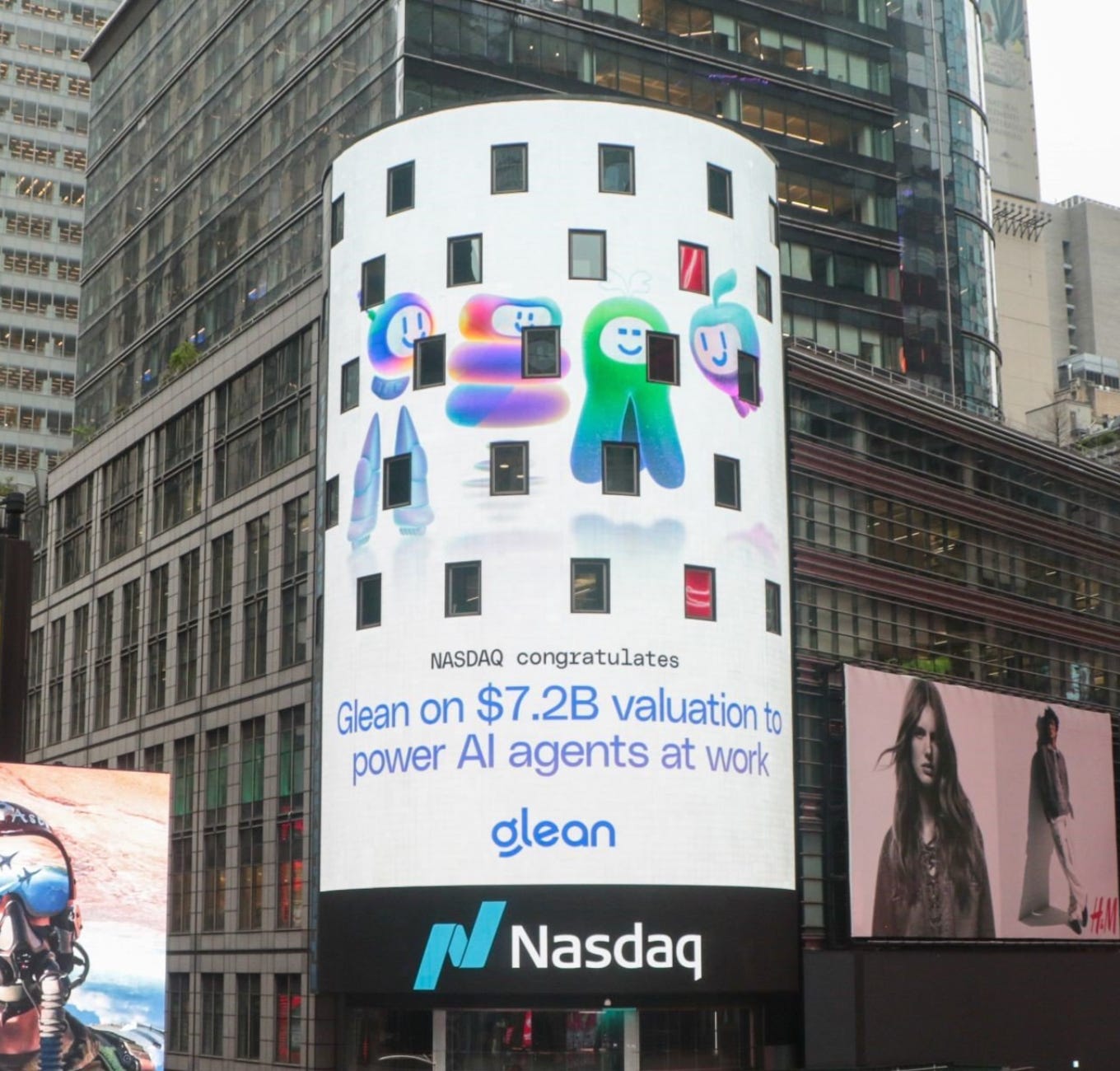
Building on this momentum, Glean’s annual recurring revenue (ARR) has already surpassed $100 million. In June, the company secured a Series F funding round from some of Silicon Valley’s most prominent investors — including Sequoia Capital, Kleiner Perkins, Khosla Ventures, Wellington, and Lightspeed Venture Partners. The round valued Glean at $7.2 billion, cementing its status as one of the most valuable enterprise AI startups in the world
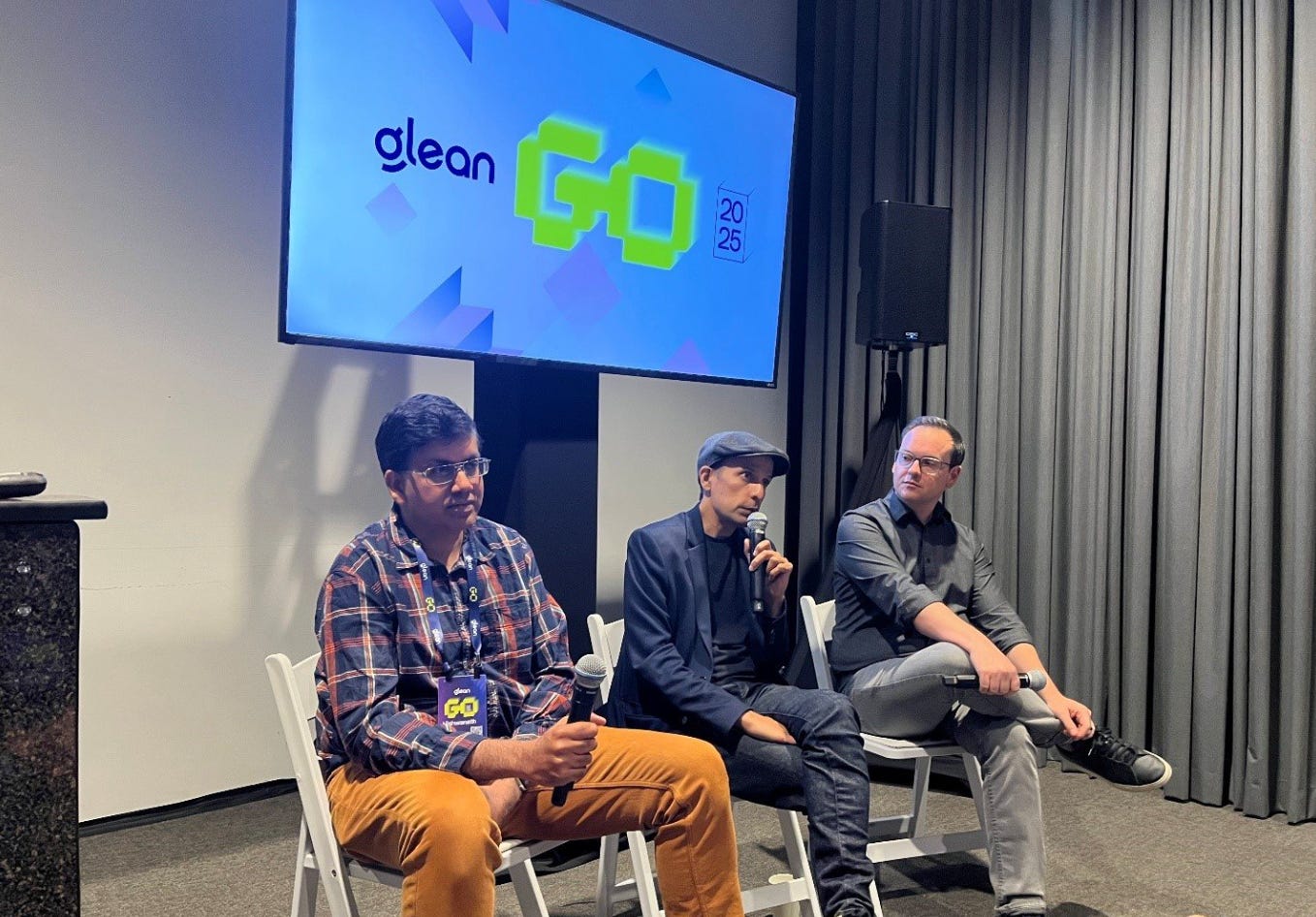
In May, I interviewed Arvind Jain, Glean’s founder and CEO, at the company’s annual conference, Glean Go. A follow-up written interview was conducted in June.
The Founding Motivation — How Did ‘Work AI’ Begin?

― Your recent interview with Forbes was interesting. I was curious about how you first thought of creating Work AI. You mentioned that you were focusing on unused internal data within enterprises. Was there a personal moment when you felt compelled to solve that problem?
“The idea for Glean didn’t come to me in a single moment of inspiration. It came from years of repeatedly facing the same frustrating problem.
At Google, we worked toward the mission of making the world’s information accessible to everyone, building expertise in making the impossible possible. But paradoxically, once you stepped inside a company—even at Google or later at Rubrik—the situation was completely different. Information existed everywhere, yet it was hard to know exactly where things were, who had access, or which version was the latest. As a result, even the most talented employees spent excessive time searching for information or recreating work that already existed. It wasn’t just inefficient; it was also demoralizing.
So yes, the idea was personal. It came from the everyday frustration of knowing that information existed, but not being able to access it when I needed it. What we want to achieve through Glean is to give everyone the ability to easily find, understand, and act on the information they need to do their best work.”
― How did you and your co-founders come together to start the company?
“We came up with the idea for Glean in late 2018 and started the company in early 2019. The product vision was clear from the start — to build a ‘Google for the workplace.’
Tony and I had spent years at Google working on technologies that made search incredibly fast, and Vish is someone I’ve known for over 30 years, since our school days. All three of us had deep backgrounds in search, and at the time, Vish was leading the search division at Facebook.
That’s how the core founding team came together. Later, we brought in additional talent from Google and Meta to complete the founding group.”
Adoption and Expansion Strategy — “Days, Not Months”
― The efficiency of deployment must be closely related to scalability. How does Glean help its clients adopt the solution quickly across their organizations?
“From the very beginning, Glean has focused on making deployment incredibly fast and seamless. Most customers complete setup in a matter of days, not months, and begin realizing value immediately. This is because Glean is designed to integrate out of the box with the tools enterprises already use, such as Google Workspace and Microsoft 365.
There’s no need for custom training or lengthy implementation cycles. Glean was built from the ground up with scalability in mind. Its fast indexing pipeline, high-performance search, and fine-grained permission system are all optimized to handle billions of documents efficiently, even accounting for temporary permissions or API limitations.
Whether an organization has 50 employees or 50,000, Glean works instantly—securely, accurately, and at scale—so customers can feel the improvement in productivity and results right away.”
Multi-LLM Operations — The Secret to Optimizing Latency and Cost
― You’re known to use multiple LLM (large language model) providers. In a real-time environment, how do you manage both speed and cost efficiency?
“We use multiple LLMs because no single model is optimized for every task. With the recent release of Glean Agent, we’ve taken that approach a step further—each stage of the agent’s process can now automatically select the model that best fits the task. This allows us to achieve the ideal balance between quality, speed, and cost at every step.
In real-time enterprise environments, latency is crucial. Glean minimizes wait times by optimizing the entire stack, from fast retrieval to lightweight agent execution. And because Glean has its own powerful search and indexing system, we can produce highly accurate answers using fewer tokens—maintaining both responsiveness and cost efficiency.”
― Do you plan to develop your own AI models?
“We’re not focused on building entirely new LLMs. Instead, our priority is developing the intelligence layer on top of them — one that deeply understands each company’s unique data, permission structures, and workflows to deliver accurate, secure, and actionable results. That’s where Glean’s true strength lies.
Through our model-agnostic architecture, we can selectively use the best-performing models while remaining flexible and scalable for each customer’s needs. Rather than reinventing foundation models, we’re focused on building real intelligence that operates effectively in everyday work — and, above all, delivering tangible value through reliable, enterprise-grade AI.”
― How does Glean ensure compliance with data protection regulations such as GDPR and HIPAA, especially in highly regulated industries like finance and healthcare?
“Glean was designed from the very beginning with enterprise-grade security and privacy at its core. Compliance with major data protection regulations, including GDPR and HIPAA, is foundational to our platform. We adhere to data residency and data minimization principles, backed by strong technical controls, configurable data location options, and strict access policies.
Unless explicitly configured otherwise, Glean never stores customer content data outside the customer’s environment and always respects existing permission structures. We also provide granular access control, audit logs, and role-based access control (RBAC) to meet the compliance requirements of highly regulated sectors such as finance, healthcare, and technology.
Additionally, Glean undergoes regular security audits and maintains SOC 2 Type II and ISO 27001 certifications, ensuring that our systems align with international standards for security and data governance. This gives customers confidence that Glean upholds the highest levels of protection, regardless of region or jurisdiction.”
• RAG (Retrieval-Augmented Generation): An approach that improves the accuracy of responses by first retrieving relevant materials—such as internal documents—before generating an answer.
• RBAC (Role-Based Access Control): A security model that restricts data access based on user roles and assigned permissions.
― How is Glean differentiated from competitors like Cohere and other enterprise AI platforms?
“Glean’s core value lies in context. We go far beyond simply performing RAG well — our platform connects an organization’s people, documents, conversations, permissions, and workflows into a single, coherent system that helps employees truly get work done.
Glean integrates natively with a wide range of SaaS tools while preserving organizational structure and access controls, surfacing exactly the right information at the right moment. And with the addition of Agents, we move beyond just providing answers — enabling users to take real, actionable steps. That’s the fundamental differentiator that defines Glean.”
― So far, Glean has primarily focused on technology, finance, and consulting firms. Are there plans to expand into other industries?
“Initially, adoption was fastest among technology companies and organizations with a high concentration of knowledge workers. Now, we’re rapidly expanding into more regulated and process-heavy sectors such as finance, healthcare, and manufacturing.
In terms of scale, Glean delivers immediate value to mid- to large-sized enterprises with hundreds or thousands of employees. As agent-based automation continues to advance, we expect growing demand from mid-sized organizations as well.”

― When facing specialized AI tools designed for sectors like law, finance, or engineering, how does Glean position itself?
“We don’t aim to compete directly with best-of-breed vertical AI tools. Instead, Glean functions as a horizontal platform that aggregates and integrates knowledge across all applications—including these specialized systems—to unify insights, workflows, and governance across the enterprise.
By offering an open, model-agnostic, and extensible platform, Glean helps organizations connect deep domain expertise from vertical AI tools within a cohesive enterprise context. This approach reduces fragmentation, minimizes redundancy, and amplifies the value of both horizontal and vertical AI investments. Rather than competition, we see this as collaboration within an interconnected ecosystem.”
― When large platforms like ChatGPT or Perplexity enter the enterprise AI space and foundational technologies like RAG become commoditized, how will Glean stay differentiated?
“What truly matters in the enterprise is context. Even if models are the same, the quality of outcomes depends on how deeply you understand the people, documents, permissions, and workflows behind them.
Glean’s core philosophy is built around security, compliance, and openness. Our platform deeply understands each organization’s structure and processes, focusing on helping people actually get work done — not just generate answers. That’s why, even in an era of ubiquitous foundation models, Glean continues to stand apart.”
― Does Glean have plans to expand its business into East Asia, including Korea?
“Our international expansion is well underway. We’re already operating in several key regions — including Western Europe, Australia, New Zealand, and across Asia in countries like Singapore, Japan, and India — and we plan to continue this momentum. Asia already represents a larger-than-expected share of our revenue compared to peers at a similar stage, and it will remain a core strategic region for us going forward.
The Asia-Pacific (APAC) region was one of our first international markets, with Japan as our entry point. We currently have some customers in Korea, though our presence is still at an early stage. In Japan, we’ve benefited greatly from partnerships that introduced us to many enterprise clients, and we hope to build similar relationships and opportunities in the Korean market as well.”

By Eric Choi
Eric Choi is CEO of Palo Alto Capital, a Silicon Valley-based private equity firm he founded after earning his MBA from the University of Michigan and working at Samsung SDI America and SK Global Development Advisors. Earlier in his career, he worked as a top-ranked equity research analyst in Asia. He is also the author of Auto Empire and several books on U.S. stocks, energy, and post-pandemic industry trends.